← Home · Underground Excavations

Geotechnical Analysis for Soft Soil Tunnels in League City

Together, we solve the challenges of tomorrow.

LEARN MORE →

Driving along I-45, you notice the flat expanse of League City—elevation barely 20 feet above sea level, crisscrossed by Clear Creek and dozens of drainage channels. What you do not see is the subsurface: up to 30 feet of high-plasticity Beaumont Formation clays, saturated and sensitive to even minor disturbance. For any tunnel project here, whether a utility corridor beneath FM 518 or a stormwater bypass under the new subdivisions west of Bay Colony, the ground behavior dictates everything. We have run enough triaxial tests on undisturbed League City samples to know this clay can lose half its undrained strength the moment water content shifts just two percent. A standard desk study simply does not capture that risk. Our geotechnical analysis for soft soil tunnels combines in-situ permeability testing with advanced lab programs to establish the real consolidation parameters before the TBM ever arrives on site.

In League City clays, we routinely measure undrained shear strengths below 500 psf at depths where most design assumptions expect twice that value—and that discrepancy is what drives tunnel face failures.

Methodology and scope

The City of League City enforces the 2018 International Building Code with local amendments, and any tunnel excavation below the water table must comply with OSHA Subpart S for trenching and shoring, even when a tunnel boring machine is specified. What makes League City different from Houston proper is the shallow groundwater—often at just 6 to 10 feet depth—and the interbedded sand lenses within the Beaumont clay that act as confined aquifers. Our characterization sequence follows ASTM D2487 for soil classification, then moves directly into CU triaxial testing per ASTM D4767 to obtain effective stress parameters. We run incremental load consolidation tests per ASTM D2435 on Shelby tube samples to generate the compression index and preconsolidation pressure, because over-consolidation ratios in this formation vary drastically over short vertical distances. For tunnel face stability calculations, we pair these lab results with CPT soundings that produce continuous tip resistance and pore pressure profiles without sample disturbance—essential when you need to identify thin silt seams that can trigger sudden blowouts during excavation.
Geotechnical Analysis for Soft Soil Tunnels in League City
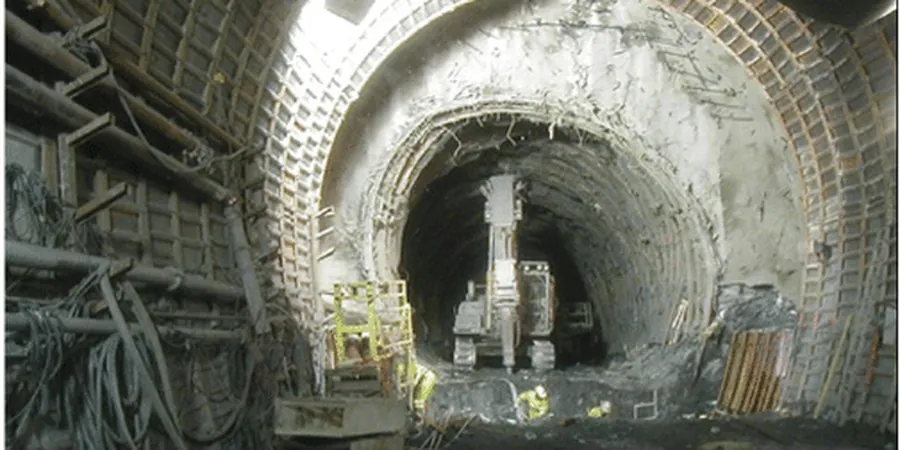
Technical reference image — League City

Local considerations

A stormwater tunnel project near the Clear Creek detention basin encountered a problem we have documented across League City: the contractor assumed a closed-face TBM would handle the clay without face pressure control. At chainage 340, they hit a sand lens only 9 feet below the creek bed, and within minutes the face collapsed, daylighting as a sinkhole in the adjacent park. The repair cost exceeded the original geotechnical budget by a factor of eight. That sand lens was not visible in the original 200-foot-spaced borings. Our approach for soft soil tunnel analysis in League City mandates pre-excavation pore pressure dissipation testing and a minimum of three continuous CPT profiles per alignment mile. Combined with the triaxial shear strength envelope from undisturbed samples, we can define the required support pressure curve with enough resolution to avoid that exact failure mode. In the Beaumont Formation, tunnel stability is not about average conditions: it is about the worst lens you did not find.

Need a geotechnical assessment?

Reply within 24h.

Email: contact@geotechnical-engineering1.org

Explanatory video

Technical parameters

ParameterTypical value
Undrained shear strength (Su)300–800 psf (Beaumont Fm.)
Liquidity Index0.8–1.4 (near Clear Creek floodplain)
Compression Index (Cc)0.25–0.45
Preconsolidation pressure (Pc)1,500–3,200 psf
Permeability (kv)1×10⁻⁷ to 5×10⁻⁶ cm/s
Groundwater depth6–12 ft below grade

Associated technical services

01

Tunnel Alignment Geotechnical Baseline Report

Full geotechnical characterization along the proposed alignment including stratigraphic profiles, groundwater monitoring over a complete seasonal cycle, and laboratory determination of strength and consolidation parameters for each lithological unit encountered.

02

Face Stability and Settlement Analysis

Finite element modeling of staged excavation sequences using PLAXIS 2D with input parameters calibrated to site-specific triaxial and consolidation data. We produce support pressure curves and surface settlement trough predictions for every sensitive receptor within the influence zone.

03

Pre-Excavation CPT and Pore Pressure Profiling

Continuous cone penetration testing with seismic module and piezocone dissipation tests at intervals not exceeding 250 feet. This identifies sand lenses, perched water zones, and abrupt strength transitions that boring logs alone will miss in League City's interbedded deposits.

Applicable standards

ASTM D4767 (CU triaxial), ASTM D2435 (consolidation), ASTM D2487 (soil classification), OSHA 1926 Subpart S, IBC 2018 (League City adopted)

Frequently asked questions

What soil conditions make tunneling in League City especially challenging?

The Beaumont Formation clays beneath League City combine high plasticity, low undrained shear strength often below 600 psf, and shallow groundwater at 6 to 10 feet. The real challenge comes from thin interbedded sand and silt lenses that act as confined aquifers: when a tunnel face intersects one, water inflow can liquefy the surrounding clay and trigger a rapid collapse. Our lab testing and CPT profiling are designed specifically to pinpoint these lenses before excavation begins.

How much does a complete geotechnical analysis for a soft soil tunnel cost in League City?

For a typical utility or stormwater tunnel alignment in League City, the full investigation including field drilling, CPT soundings, laboratory testing, and engineering analysis typically ranges from US$4,510 to US$16,010 depending on alignment length, number of borings, and testing scope. We provide a detailed proposal after reviewing the project alignment and depth.

Which laboratory tests are essential for soft soil tunnel design?

At minimum, we run CU triaxial tests per ASTM D4767 for effective stress strength parameters, one-dimensional consolidation tests per ASTM D2435 for settlement prediction, and Atterberg limits with natural water content to establish the liquidity index. For League City clays, we also recommend constant-rate-of-strain consolidation when time constraints exist, and unconsolidated-undrained triaxial for short-term face stability checks.

How far in advance should we commission the geotechnical investigation before tunnel construction?

In League City, we recommend starting the field investigation at least 10 to 14 weeks before the planned excavation date. This allows time for installing piezometers and collecting at least two months of groundwater data to capture seasonal variations, plus the laboratory program that typically requires four to six weeks for consolidation and triaxial testing on undisturbed samples.

Can you perform the analysis if the tunnel alignment runs under existing structures or roadways?

Yes. We design the investigation to work within League City right-of-way constraints, using angled boreholes and surface-deployed geophysics where vertical access is limited. The settlement analysis we deliver includes building damage assessment per Burland criteria, so you know exactly which structures require pre-construction condition surveys and monitoring during excavation.
Location and service area

We serve projects across League City and its metropolitan area.

View larger map