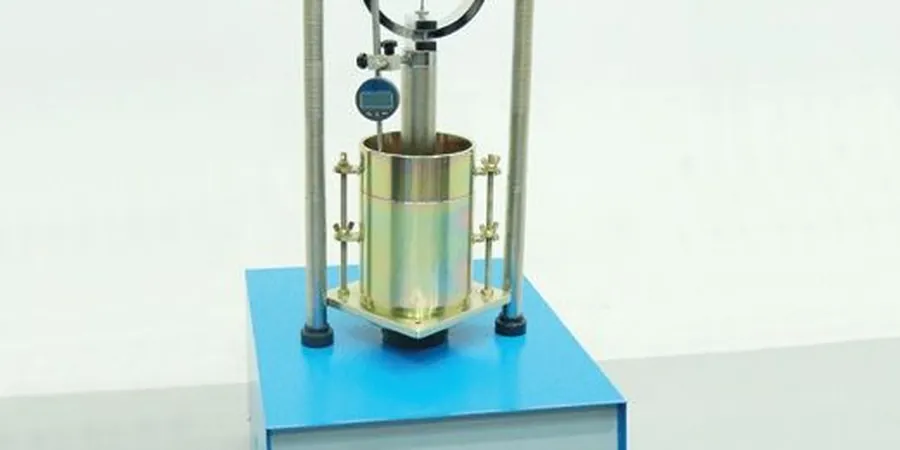
The soil profile between Clear Creek and Dickinson Bayou can look dramatically different within a half-mile in League City. One site near the 518 corridor might hit sandy loam at two feet, while another farther south toward the floodplain finds fat clay extending past eight feet. For pavement engineers, this variability means a single assumed CBR value is never safe. Laboratory California Bearing Ratio testing under ASTM D1883 gives us a controlled, repeatable measurement of subgrade strength, independent of field moisture fluctuations. We run both soaked and unsoaked CBR on remolded specimens compacted to project density targets, so the design accounts for the worst-case saturation scenario that League City’s humid subtropical climate and occasional ponding can create. For projects where deeper bearing layers matter, we often pair the CBR lab work with site-specific compaction control data to verify that what leaves the lab matches what gets built.
Soaked CBR on Gulf Coast clays can drop below 3 percent once saturation reaches field capacity—pavement thickness doubles compared to an unsoaked design assumption.
Methodology and scope
One thing we see repeatedly in League City is that a soil’s visual classification does not predict its CBR value. Two clays with similar plasticity can show a 300 percent difference in soaked CBR just because of silt content and compaction moisture sensitivity. Our lab procedure starts with a standard or modified Proctor to establish the moisture-density relationship, then remolds specimens at the target water content for a three-point CBR curve. We apply the surcharge weight that corresponds to the final pavement section, typically 10 or 15 pounds for flexible pavement. Penetration readings at 0.1 and 0.2 inches are corrected against the standard crushed-stone reference, and we report both the corrected CBR and the swell percentage after a 96-hour soak. For League City projects near tidal channels, where groundwater may be within four feet of finished grade, the soaked CBR often governs the structural number, and we flag any swell exceeding 1.5 percent as a constructability risk that may require lime treatment or undercut.
Frequently asked questions
What is the difference between soaked and unsoaked CBR, and which one should I use for League City pavement design?
Unsoaked CBR measures the strength of a specimen compacted at field moisture without saturation, while soaked CBR submerges the specimen for 96 hours to simulate long-term groundwater and rainfall effects. In League City, where annual rainfall exceeds 55 inches and shallow groundwater is common, the soaked value almost always governs. We recommend using the soaked CBR for any flexible or rigid pavement structural design per AASHTO 93, and reserving the unsoaked value only for temporary construction platforms or dry-season staging.
How much does a laboratory CBR test cost for a League City project?
A single-point soaked CBR with Proctor and swell measurement typically runs between US$120 and US$190, depending on whether you need a one-point, two-point, or three-point curve and the number of specimens. A full three-point CBR with companion index testing—Atterberg limits, gradation, and sulfate screening—generally falls at the upper end of that range. We provide a per-sample quote after reviewing the boring logs and project pavement section.
How many CBR specimens do I need for a commercial site in League City?
The number depends on soil variability across the site. For a typical commercial pad or parking lot under five acres with relatively uniform geology, we recommend one CBR test per major soil unit encountered in the borings—usually two or three specimens. If the site straddles different geomorphic units, such as Pleistocene terrace deposits and Holocene floodplain clays, each unit needs its own CBR determination. We work from your geotechnical boring logs to define the minimum statistically valid testing program.
Can you run CBR on stabilized subgrade or base material?
Yes. We regularly test cement-treated, lime-treated, and fly-ash-stabilized soils and base courses for League City projects. The procedure follows ASTM D1883 with modifications for curing time—typically seven days moist cure at controlled temperature—before the 96-hour soak. We report both the immediate CBR after compaction and the cured, soaked CBR so the pavement designer can evaluate the strength gain from stabilization and adjust the structural number accordingly.