← Home · Slopes & Walls

Slope Stability Analysis in League City: Technical Requirements and Local Soil Challenges

Together, we solve the challenges of tomorrow.

LEARN MORE →

IBC Chapter 18 and the Texas Geotechnical Practice manual require a site-specific slope stability analysis before any cut or fill operation exceeds five feet in vertical relief. In League City, this threshold becomes critical along the Clear Creek tributaries and detention pond embankments where the local Beaumont Formation clays dominate the subsurface profile. The analysis quantifies the factor of safety against rotational and translational failure. It accounts for the perched water tables common after hurricane-season rainfall. Our laboratory runs consolidated-undrained triaxial tests to derive the effective stress parameters that feed the limit equilibrium models. For deeper infrastructure, CPT testing provides continuous stratigraphy without sample disturbance, a key advantage when identifying thin silt seams that control failure surfaces. The final report includes both short-term end-of-construction and long-term steady-state seepage conditions.

A factor of safety of 1.5 for permanent slopes is the minimum under IBC; for temporary construction slopes, 1.3 may be accepted if monitoring is in place.

Methodology and scope

League City sits at an average elevation of just 20 feet above sea level, with surface drainage dictating the feasibility of most earthwork designs. The high-plasticity CH clays in the area exhibit liquid limits often exceeding 55 percent and swell pressures above 3,000 psf, which introduces a time-dependent component to slope performance. A proper analysis here must incorporate the residual shear strength parameters from ring shear testing, not just peak values. We model the progressive failure mechanism common in overconsolidated Beaumont clays. The geometry of each cross-section is built from LiDAR or total station surveys. Pore pressure conditions are assigned based on piezometer readings taken during the wet season. When the project involves a retaining structure at the toe, the stability model integrates retaining wall systems so that the wall's passive resistance and the global slope stability are evaluated together, eliminating the disconnect that often leads to underdesign.
Slope Stability Analysis in League City: Technical Requirements and Local Soil Challenges
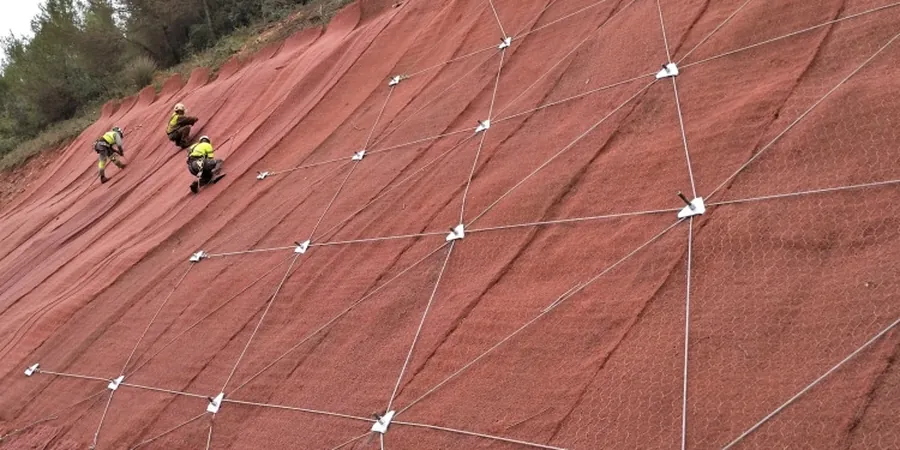
Technical reference image — League City

Local considerations

A frequent oversight in League City subdivisions is constructing detention ponds with 2:1 side slopes without accounting for rapid drawdown conditions. The clay embankment becomes saturated during a storm event; when the water level drops quickly, the excess pore pressure cannot dissipate. The effective stress drops to nearly zero. Slopes that were stable under steady seepage fail within hours. A rigorous analysis runs the rapid drawdown scenario as a separate load case using three-stage undrained strength envelopes. Another risk arises when developers import sandy fill to raise pad elevations above the floodplain. The interface between the compacted fill and the native clay creates a permeability contrast that traps water. Without a drainage blanket or chimney drain designed into the cross-section, the phreatic surface builds up, and the factor of safety degrades over time.

Need a geotechnical assessment?

Reply within 24h.

Email: contact@geotechnical-engineering1.org

Technical parameters

ParameterTypical value
Minimum FoS (permanent slope)1.5
Minimum FoS (temporary cut)1.3
Analysis methodLimit equilibrium (Spencer, Morgenstern-Price)
Shear strength inputEffective stress (c', φ') from CIU triaxial
Groundwater modelingPhreatic surface from piezometer data
Seismic coefficient (kh)0.05–0.10 per USGS 2475-year PGA
Typical soil unit weight (Beaumont clay)115–125 pcf

Associated technical services

01

Limit Equilibrium Stability Report

We use Spencer and Morgenstern-Price methods in Slide2 or Slope/W to satisfy both force and moment equilibrium. Each report includes a sensitivity analysis on the key parameters: cohesion, friction angle, and phreatic surface elevation.

02

Construction Monitoring and Instrumentation Plan

For slopes steeper than 3:1 or those protecting habitable structures, we prepare an instrumentation layout with inclinometers and standpipe piezometers. Readings are taken weekly during earthwork and monthly for six months post-construction.

Applicable standards

IBC 2021 Chapter 18 – Soils and Foundations, ASCE 7-22 Section 11.8 – Seismic Slope Stability, ASTM D4767 – Consolidated Undrained Triaxial Compression Test, FHWA-NHI-05-123 – Soil Slope and Embankment Design

Frequently asked questions

What is the typical cost range for a slope stability analysis on a League City residential lot?

For a single-family lot requiring analysis of a detention pond embankment or a cut slope up to 15 feet high, the fee ranges from US$1,400 to US$4,150. The final cost depends on the number of cross-sections, the soil borings required for strength parameters, and whether rapid drawdown or seismic cases must be modeled. A proposal is issued after reviewing the grading plan.

Which shear strength parameters are used for Beaumont Formation clays in stability models?

We use effective stress parameters (c' and φ') from consolidated-undrained triaxial tests with pore pressure measurement per ASTM D4767. For first-time slides in stiff intact clay, peak values are appropriate. For reactivated landslides or pre-sheared surfaces, we apply residual strength from ring shear testing, which can be 40 to 60 percent lower than peak friction angles.

Does League City require a seismic coefficient for slope stability?

Yes. Under IBC 2021 and ASCE 7-22, League City falls within a region where the 2,475-year PGA is approximately 0.05g to 0.10g. A pseudo-static analysis with a horizontal seismic coefficient (kh) equal to half the PGA is typically applied. For critical structures, a Newmark displacement analysis may be required to demonstrate tolerable permanent deformation.

How long does the analysis and report take after the field investigation?

From receipt of laboratory triaxial results and final survey cross-sections, a standard report with three to five critical sections is completed in 12 to 15 business days. Expedited turnaround in seven days is available when scheduling allows. The timeline extends if multiple wet-season groundwater scenarios require iterative modeling.
Location and service area

We serve projects across League City and its metropolitan area.

View larger map