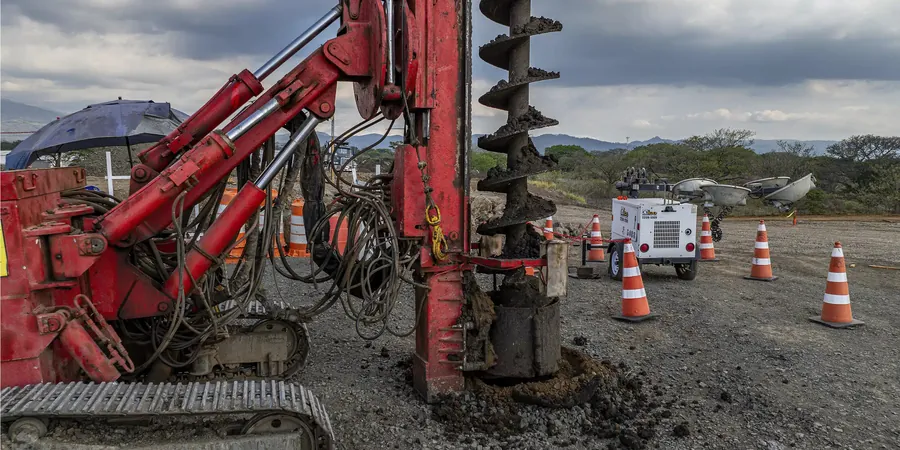
League City sits on the upper Texas Gulf Coast, where the near-surface geology is dominated by Pleistocene Beaumont Formation clays that alternate between stiff, fissured deposits and soft, compressible layers. Seasonal moisture swings push these expansive clays through shrink-swell cycles that can lift and drop light structures by several inches, while the shallow water table — often less than 6 feet below grade — complicates any excavation. When conventional shallow footings become too risky or require over-excavation depths that hit groundwater, stone column design becomes the practical ground improvement route. Our team applies vibro-replacement methods that densify the surrounding matrix and create stiff, vertical drainage elements through the problematic upper strata. In a city where Clear Creek and its tributaries shape drainage patterns and where development continues to push into lower-lying tracts, the decision to reinforce the ground with stone columns has to be backed by thorough site investigation. We pair CPT testing with laboratory classification to map the compressible lens before sizing each column.
A single stone column in Beaumont clay can reduce post-construction settlement by 60 percent while cutting consolidation time in half through radial drainage.
Methodology and scope
The Beaumont clay in League City typically shows undrained shear strengths between 800 and 1,500 psf in the upper 15 feet, with liquid limits exceeding 50 percent and plasticity indices above 25 — numbers that put it squarely in the CH fat clay category per ASTM D2487. These soils lose strength rapidly when saturated, which is exactly what happens during a tropical storm or a wet winter, and that is why the city’s adopted IBC requires foundation alternatives or ground improvement once the allowable bearing pressure drops below 1,500 psf. A stone column installation in this profile works by replacing roughly 20 to 35 percent of the soft soil with compacted, clean aggregate, forming a composite mass that can support strip footings, tank rings, and embankments on sites where total and differential settlement would otherwise exceed tolerable limits. We verify the improvement with pre- and post-installation
SPT drilling and occasionally with
MASW surveys to confirm that shear wave velocities have increased enough to meet the design modulus. The columns also act as vertical drains, accelerating consolidation of the inter-column soil, which is a critical advantage when construction schedules are tight and the client cannot wait months for surcharge settlement to run its course.
Local considerations
IBC Chapter 18 and ASCE 7-22 require ground improvement designs to address both static bearing failure and seismic performance, and in League City the seismic demand — though modest at SDS values around 0.10–0.15g — becomes significant when loose silty sand lenses are present within the clay profile. These lenses can trigger a partial loss of lateral confinement during cyclic loading, reducing the stone column’s stiffness and potentially allowing excessive settlement under the design earthquake. A second risk specific to the coastal plain is chemical degradation of the aggregate: slightly acidic groundwater and sulfate-rich soils common in the area can attack limestone-based backfill over time, so we specify inert, crushed granite or similar durable stone tested for soundness per ASTM C88. Without this precaution, columns installed today could lose permeability and strength within a decade. The high groundwater also demands careful construction sequencing, because a wet, collapsing hole during installation compromises compaction and forces costly re-drilling — a scenario we avoid by maintaining positive head and using casing where the clay is too soft to stand open.
Applicable standards
ASTM D1586-18 — Standard Test Method for Standard Penetration Test (SPT), ASTM D2487-17 — Unified Soil Classification System, ASCE 7-22 — Minimum Design Loads for Buildings and Other Structures, IBC 2021 Chapter 18 — Soils and Foundations, ASTM C88-18 — Soundness of Aggregates by Sodium Sulfate, FHWA-NHI-16-072 — Ground Improvement Methods (Vol. II)
Frequently asked questions
What does stone column design cost for a typical League City residential lot?
For a standard single-family lot in League City, stone column design and installation typically ranges from US$1,340 to US$5,170, depending on treatment depth, column count, and access constraints. Sites with very soft clay or a water table within 3 feet of the surface tend toward the upper end because casing or temporary backfill is needed to keep the hole stable during construction.
How do you confirm the stone columns are working in Beaumont clay?
We run SPT or CPT soundings at the column center and at the midpoint between columns after installation, and compare the blow counts or tip resistance to the pre-treatment baseline. On critical projects we also perform a plate load test per ASTM D1194 directly on top of a column to measure the actual load-settlement curve under design pressure.
Can stone columns be installed when the water table is less than 5 feet deep?
Yes, and in League City that situation is the rule rather than the exception. The wet top-feed method works well under a high water table because the vibrator can penetrate through saturated clay without dewatering, but we often use a temporary casing through the upper 8 to 10 feet if the clay is too soft to maintain a stable annulus around the probe.