← Home · Geophysics

MASW & VS30 Testing in League City: Site Classification That Holds Up

Together, we solve the challenges of tomorrow.

LEARN MORE →

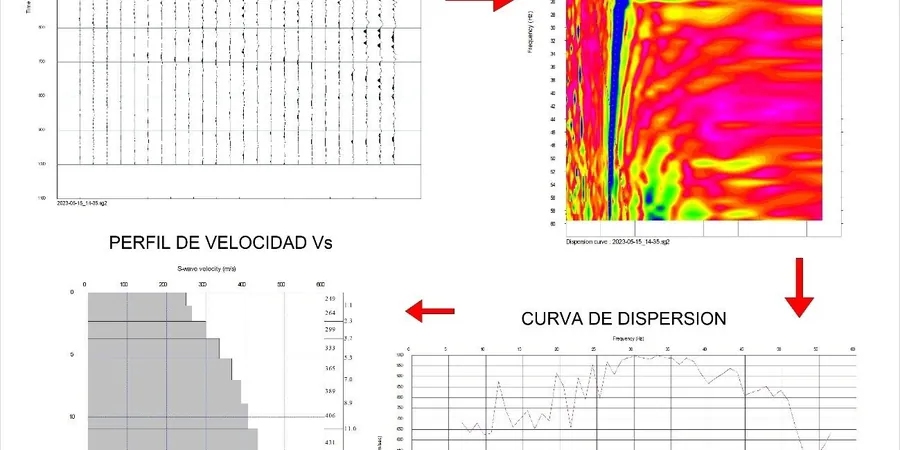
A three-story medical office building near the South Shore Boulevard corridor was stalled for two months. The owner had borings with SPT blow counts but the structural engineer refused to release the foundation design. Why? The IBC Site Class was still a guess. League City sits on a mix of Pleistocene Beaumont Formation clays and recent floodplain deposits along Clear Creek. You can't infer Vs30 from blow counts alone in these layered coastal soils. When the contractor called us, we deployed a 48-channel MASW array across the parking lot, collected Rayleigh wave dispersion over a 100-foot spread, and delivered an inversion profile the next morning. The shear wave velocity data showed a stiff clay layer at 18 feet with Vs exceeding 1,200 ft/s, pushing the site firmly into Class C. The engineer got what they needed, and the foundation went in the following week. For similar soft-soil settings, we often pair the MASW survey with a seismic refraction profile to map the top of the Beaumont clay contact where the velocity contrast is sharpest.

A measured Vs30 of 1,250 ft/s versus an assumed 650 ft/s can drop the seismic base shear by a third. That number shows up on the structural drawings.

Methodology and scope

The most common mistake we see in League City is assuming the entire site is Site Class D because a boring log shows stiff clay at 50 feet. That assumption drives up seismic design forces by 20 to 40 percent and inflates the structural frame cost. The IBC allows you to use measured Vs30 per ASCE 7 Chapter 20, but only if the data is collected and processed correctly. Our crew runs active-source MASW with 4.5 Hz geophones spaced at 2.5 feet, using a 20-pound sledgehammer source and 24-bit acquisition. We process the dispersion image with high-resolution frequency-wavenumber transforms, then invert for a layered Vs profile. The Vs30 value is computed per the travel-time averaging method defined in ASCE 7-16 Section 20.4. The result is a defensible Site Class A through F that the reviewing engineer can sign off on without hesitation. In areas where the near-surface is heavily desiccated clay, we recommend coupling the MASW with grain-size analysis from a companion boring to correlate low-velocity zones with sand lenses that might liquefy under the design earthquake.
MASW & VS30 Testing in League City: Site Classification That Holds Up
Technical reference image — League City

Local considerations

ASCE 7-16 Section 11.4.3 explicitly permits site-specific Vs30 measurement to refine the mapped spectral accelerations Ss and S1. In League City, the default USGS National Seismic Hazard Model assigns a Site Class D assumption unless the geotechnical report proves otherwise. The risk is financial and structural: a misclassified site can overdesign the lateral system by 30 percent or, worse, under-design it if a soft clay lens goes undetected. The Beaumont Formation clays exhibit desiccation crusts in the upper 5 to 10 feet that show high blow counts but mask lower-velocity material below. MASW reads through that crust because surface waves sample stiffness at depth without mechanical disturbance. For critical facilities near the flood-prone Clear Creek basin, the local building official increasingly requires a site-specific Vs profile before issuing the foundation permit. We also reference the NCEER guidelines when screening for liquefaction in sandy interbeds that the MASW profile identifies as zones with Vs below 650 ft/s.

Need a geotechnical assessment?

Reply within 24h.

Email: contact@geotechnical-engineering1.org

Explanatory video

Technical parameters

ParameterTypical value
MethodActive-source MASW, 48-channel linear array
Geophone frequency4.5 Hz vertical-component
Spread length100 to 240 ft (site-adaptive)
Source20 lb sledgehammer on aluminum plate
Vs30 computationASCE 7-16 Section 20.4 travel-time method
Site Classes resolvedA through F per IBC Table 1613.2.2
Minimum investigation depth100 ft below grade (or per project specs)

Associated technical services

01

Standard Vs30 Site Classification

One to three MASW lines, dispersion curve extraction, inversion to layered Vs profile, Vs30 calculation per ASCE 7, IBC Site Class letter, and a PDF report with interpreted cross-sections. Typical turnaround is three business days.

02

Combined Seismic & Geotechnical Package

MASW survey plus companion SPT borings and laboratory index tests. We correlate Vs with SPT N-values and fines content, then deliver a unified report covering site class, liquefaction screening, and bearing capacity recommendations.

Applicable standards

ASCE 7-16, IBC 2021 Section 1613, ASTM D7400-19, NEHRP Recommended Provisions

Frequently asked questions

How long does a MASW survey take on a typical League City lot?

Fieldwork for one or two spreads on a standard commercial lot takes about half a day. We stake the line, lay out the geophones, and collect multiple shots at each end to stack the dispersion image. You get the preliminary Vs30 value by the next afternoon, and the full report within three business days.

Can MASW work on pavement or inside an existing building?

Yes, with some caveats. On asphalt or concrete we use base plates with a thin sand layer to improve coupling. It works well on parking lots and warehouse slabs. Inside a building, we need at least 50 feet of clear space and we watch for rebar interference in the dispersion image. We have run successful lines inside tilt-wall structures around the Gulf Freeway corridor.

What does a MASW survey cost for a single-family home site in League City?

For a single residential lot, a basic MASW survey with Vs30 classification runs between US$1,530 and US$2,760 depending on the number of spreads and whether we pair it with a test pit for soil description. Custom home builders near the Clear Lake waterfront typically need two lines to capture lateral variability.

How deep can MASW resolve the Vs profile?

The rule of thumb is roughly half the maximum recorded wavelength. With a 240-foot spread and a strong sledgehammer source, we reliably resolve shear wave velocity down to 100 or 110 feet. That covers the typical depth of influence for shallow foundations and most pile groups in the League City area. For deeper targets we switch to a passive-source array or combine MASW with downhole seismic.
Location and service area

We serve projects across League City and its metropolitan area.

View larger map