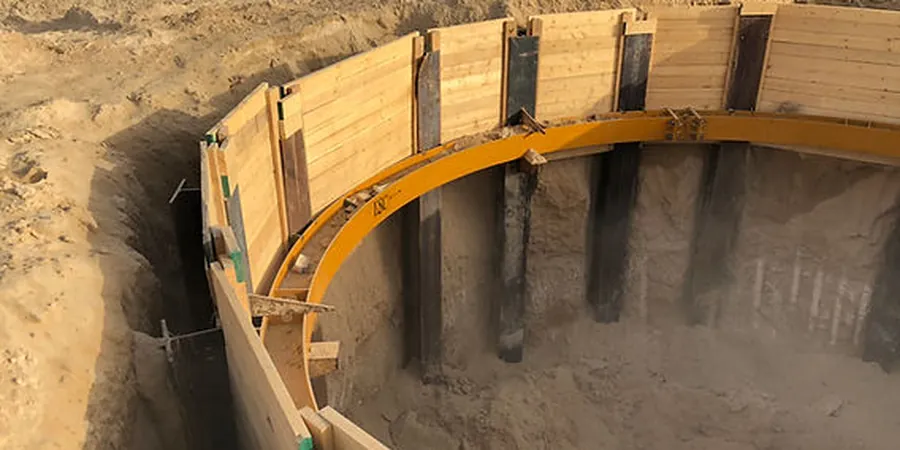
Walking a project site near Clear Creek, the first thing you notice is the ground—gray, sticky clay that holds water like a sponge. League City sits on the Beaumont Formation, a layer of Pleistocene-age clay that shrinks and swells with every rain event and dry spell. We’ve seen slabs crack within two years when the soil wasn’t properly investigated. That’s why deep foundations aren’t an upgrade here; they’re the baseline. A CPT test gives us a continuous soil profile without disturbing the clay’s structure, while Atterberg limits tell us exactly how reactive that clay is going to be when the summer drought hits. We combine those results with liquefaction analysis because a surprising number of League City parcels sit on loose sand lenses that can lose strength during the long-period ground motion we get from distant earthquakes.
In League City, the bearing stratum sits 25 to 40 feet below the active moisture zone—everything above that moves with the seasons.
Methodology and scope
League City’s growth from a railroad stop to a 115,000-person suburb happened fast, and a lot of the development pushed into areas that were once coastal prairie marsh. That history shows up in the borings—organic silt layers, pockets of uncompacted fill, and groundwater at three to five feet. A reliable pile foundation design here starts with understanding that the bearing stratum is often 25 to 40 feet down, well below the active moisture zone. We specify driven concrete piles or drilled shafts depending on access and noise restrictions, and we always run lateral load checks because lateral spreading from nearby bayou banks is a real concern. The
stone columns technique can also improve the upper clay layer before pile installation, reducing the risk of negative skin friction when the soil consolidates around the shaft.
Our approach ties into the IBC Chapter 18 requirements for deep foundations, and we cross-check the axial capacity with ASTM D1143 static load test methods when the project budget allows. For the expansive upper stratum, we often recommend isolating the pile cap from the ground with a void form—an old trick that still works better than most fancy solutions. We also look hard at the pile group efficiency; in League City’s soft clay, the group settlement can exceed the single-pile settlement by 15 to 20 percent if you don’t account for the interaction effect.
Local considerations
The Gulf humidity isn’t just uncomfortable—it rewrites the rules for foundation engineering. League City gets about 54 inches of rain a year, often delivered in tropical bursts that saturate the clay and trigger volume changes you can measure with a tape measure. Pair that with a hurricane wind load that demands 150-plus mph design resistance, and you’ve got a pile that has to handle both vertical settlement and significant lateral demand. We’ve reviewed projects where the pile-to-cap connection was detailed for gravity loads only; one good storm surge up Clear Creek and those assumptions fall apart. Uplift from wind overturning can unseat a poorly connected pile, and in a slab-on-grade neighborhood that’s a catastrophic failure. We also factor in scour potential if the site is within the 500-year floodplain—losing two or three feet of soil around a pile group changes the unbraced length and the buckling capacity, something the standard prescriptive tables don’t address. Our designs always include a scour analysis and, where needed, a deeper socket into the Beaumont clay’s underlying stiff stratum.
Applicable standards
IBC 2021 Chapter 18 – Deep Foundations, ASCE 7-22 – Minimum Design Loads (wind, seismic, flood), ASTM D1143 – Standard Test Methods for Deep Foundation Elements Under Static Axial Compressive Load, ASTM D1586 – Standard Penetration Test (SPT), ASTM D2487 – Classification of Soils for Engineering Purposes, FHWA-NHI-16-009 – Drilled Shafts: Construction Procedures and Design Methods
Frequently asked questions
How much does pile foundation design cost for a League City project?
For a typical residential or light commercial structure in League City, pile foundation design fees run between US$1,480 and US$5,710 depending on the number of piles, the depth to bearing stratum, and whether load testing is required. A larger commercial job with lateral analysis and scour studies will land at the upper end of that range.
What pile type works best in League City’s expansive clay?
Driven precast concrete piles are common because they displace and compact the clay during installation, improving shaft friction. However, if vibration is a concern near existing homes, drilled shafts with casing through the active zone are a better choice. Both require a design that isolates the pile cap from the swelling upper soil.
Do League City projects require a scour analysis for piles?
If the site falls within the FEMA 500-year floodplain—which covers a significant portion of League City near Clear Creek and its tributaries—a scour analysis is mandatory per IBC and local ordinance. We calculate the expected scour depth and adjust the unbraced pile length accordingly, sometimes deepening the socket by several feet to maintain lateral stability.