← Home · In-Situ Testing

Field Density Testing (Sand Cone Method) in League City: ASTM D1556 Compliance

Together, we solve the challenges of tomorrow.

LEARN MORE →

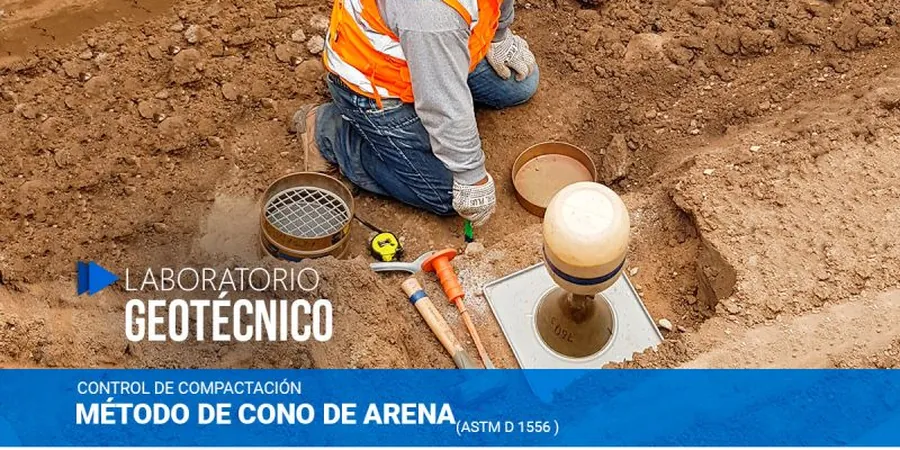
Compaction on the Gulf Coast prairie isn't just about hitting a number. In League City, where the underlying Beaumont Formation clays swell and shrink with moisture, ASTM D1556 is the only way to know if your fill is actually dense enough to resist settlement. We run sand cone density tests on commercial pads, residential plats, and utility trenches every week. Most failures we see come from a bad moisture-density relationship, not just insufficient passes. Before we even calibrate the cone, a Proctor test establishes the target dry density for your specific borrow source. On sites near Clear Creek where the ground stays wet, we often combine the sand cone with in-situ permeability to understand how water moves through the compacted layer.

A nuclear gauge gives you a number in 60 seconds. A sand cone gives you the truth in 20 minutes.

Methodology and scope

Last month we were on a tilt-wall job off SH 96 where the slab-on-grade kept failing the proof roll. The fill was a silty sand from a local pit, placed in 12-inch lifts. The contractor was hitting 95% on the nuke gauge, but the sand cone told a different story. The gauge was reading high because it was calibrated for a drier material. We pulled 8 sand cone tests across the pad. Five were below 92%. The fix was simple: reduce lift thickness to 8 inches and add water. That's the value of a volumetric test. You can't fool a known volume of Ottawa sand. For deep utility backfill in the same neighborhood, we also run SPT drilling to verify the native clay's bearing capacity before the trench box comes out, ensuring the pipe bedding doesn't settle differently than the surrounding soil.
Field Density Testing (Sand Cone Method) in League City: ASTM D1556 Compliance
Technical reference image — League City

Local considerations

We see a pattern in League City subdivisions built on old rice fields. The fill is placed during a dry August, passes compaction easily, and then the October rains come. The Beaumont clay swells, the fill softens, and the floor slabs crack. A sand cone test run in August won't catch the problem if the moisture content wasn't checked against the optimum for that borrow. The risk isn't just low density; it's high moisture sensitivity. If the fill is compacted wet of optimum, you're building in future heave. Dry of optimum, and the slab settles when the first irrigation system leaks. That's why our field reports always flag the moisture content relative to the Proctor curve, not just the density percentage.

Need a geotechnical assessment?

Reply within 24h.

Email: contact@geotechnical-engineering1.org

Technical parameters

ParameterTypical value
Test standardASTM D1556 / AASHTO T 191
Calibration sandGraded Ottawa sand (C-109 or C-190)
Test hole volumeApprox. 0.1 ft³ (varies by max particle size)
Max particle size for test2 inches (50 mm); larger rock requires ring correction
Reported resultsWet density, dry density, moisture content, % compaction vs. Proctor
Typical test depth6 to 8 inches (lift thickness)
Frequency per specOne test per 1,500–2,500 ft² per lift (per IBC / project spec)

Associated technical services

01

Sand Cone Field Density

ASTM D1556 testing on building pads, parking lots, and utility backfill. We provide same-day density and moisture reports for your compaction crew.

02

Modified & Standard Proctor

ASTM D698 and D1557 lab compaction curves to establish the target dry density for your specific fill material before field testing begins.

03

Nuclear Gauge Correlation

We calibrate your Troxler gauge against sand cone results on your actual material, eliminating systematic errors from generic factory curves.

04

Fill Material Evaluation

Sieve analysis and Atterberg limits on borrow sources. We identify gap-graded or plastic soils that will cause compaction headaches before they reach the site.

Applicable standards

ASTM D1556-15e1: Standard Test Method for Density and Unit Weight of Soil in Place by Sand-Cone Method, ASTM D698-12: Standard Test Methods for Laboratory Compaction Characteristics of Soil Using Standard Effort, AASHTO T 191: Standard Method of Test for Density of Soil In-Place by the Sand-Cone Method, IBC 2021 Chapter 18: Soils and Foundations

Frequently asked questions

What does a sand cone density test cost in League City?

A standard ASTM D1556 field density test with same-day report runs between US$110 and US$140 per point, depending on the number of tests and site location within the Galveston County area. Most projects budget 6 to 10 tests per day for continuous compaction control.

Why use the sand cone method instead of a nuclear gauge?

The sand cone is a direct volumetric measurement. A nuclear gauge infers density from radiation backscatter and can be thrown off by soil chemistry, moisture variation, or poor probe seating. When test results are challenged or a proof roll fails, the sand cone is the referee method accepted by Harris County and Galveston County engineers.

How many sand cone tests does my project need?

The International Building Code (IBC 2021) and typical geotechnical specs call for one field density test per 1,500 to 2,500 square feet per lift, with a minimum of 3 tests per lift for small areas. We write the testing plan based on your project's earthwork phasing so no lift gets covered without a passing result.
Location and service area

We serve projects across League City and its metropolitan area.

View larger map