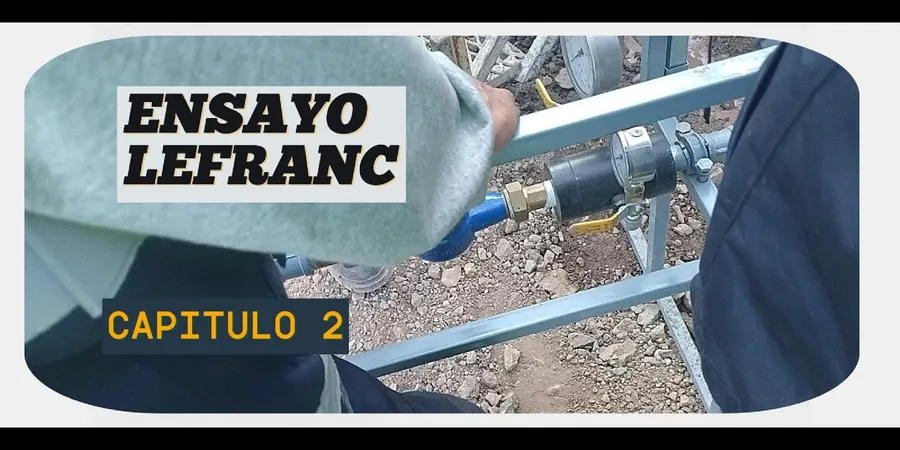
We ran a series of Lugeon tests last fall for a detention basin expansion off West Walker Street, right where the old floodplain deposits transition into the Beaumont Formation clays. The contractor had assumed uniform permeability across the site based on a single lab test, but we were seeing 10 to 50 Lugeon units in the upper 15 feet of silty sand while the underlying stiff clay barely took 2 units. That kind of vertical contrast is exactly why a field permeability test in League City isn't optional when groundwater control makes or breaks the earthwork schedule. In-situ methods like the Lefranc test for soil and the Lugeon test for rock intervals give you hydraulic conductivity values tied to actual stratigraphy, not remolded lab specimens. For any project within the Clear Creek watershed or near the Dickinson Bayou drainage basin, where seasonal perched water and relic channel sands create unpredictable flow paths, combining field permeability data with a CPT soil profile across the footprint lets the design team size dewatering systems and cutoff walls with real numbers instead of textbook ranges.
A single Lugeon test across a fractured clay layer tells you more about real seepage potential than a dozen lab permeameter runs on intact specimens.
Local considerations
The field setup we mobilize for permeability testing in League City involves a truck-mounted drill rig, twin pneumatic packers with a water swivel assembly, a calibrated flowmeter and pressure transducer array, and a data logger that records flow and pressure at one-second intervals throughout each pressure stage. The equipment is straightforward, but the real risk sits in how the data gets used – or misused. A Lefranc test run without proper filter cake removal or a Lugeon stage where the packer loses seal against a weathered claystone borehole wall will produce K-values that look plausible on a log but underestimate true mass permeability by an order of magnitude. We've reviewed reports from sites near the Gulf Freeway where designers accepted a single-stage slug test result as representative of an entire excavation depth, only to hit flowing sands at 18 feet that flooded the footing excavations and delayed the project six weeks. In League City's layered coastal plain deposits, the standard of care demands at least three test intervals per borehole, with packer seating verified by pressure-decay checks between stages. When the investigation is tied to a deep excavation monitoring plan, the permeability profile directly informs the dewatering well spacing and pump capacity needed to maintain a dry working platform through the wet season.
Frequently asked questions
What is the cost range for field permeability testing in League City?
For a typical investigation involving two to three Lefranc test intervals or a single Lugeon profile with multiple pressure stages, project costs in League City generally range from US$600 to US$1,010, depending on mobilization distance, borehole depth, and the number of test intervals required. The final scope is always tailored to the site stratigraphy and the hydraulic questions the design team needs answered.
When should I specify a Lugeon test instead of a Lefranc test?
The choice comes down to the material being tested. Lefranc tests work well in soils – clays, silts, sands – where a slotted screen can be placed in an open borehole. Lugeon tests are designed for rock or heavily indurated layers where you need pneumatic packers to isolate a discrete interval and apply staged pressures. In League City, we often use Lefranc in the upper Beaumont Formation clays and switch to Lugeon when the borehole encounters the cemented sand or calcareous sandstone layers that appear at depths of 25 to 40 feet in some areas.
How many test intervals do you recommend per borehole?
For a site investigation in the coastal plain deposits around League City, we typically run a minimum of three test intervals per borehole, spaced to capture the vertical variation in stratigraphy. If the upper 10 feet is desiccated clay with fissures, the next 15 feet is competent Beaumont clay, and the interval below that hits a water-bearing sand lens, each of those zones can have hydraulic conductivity values that differ by two orders of magnitude. Testing only one zone and extrapolating is the most common mistake we see in dewatering design failures.
How do you interpret Lugeon test results for fracture flow versus matrix permeability?
We plot the flow rate against effective pressure for all five stages and analyze the shape of the curve. A straight line through the origin indicates laminar flow through the rock matrix. Hysteresis loops – where the descending pressure limb plots above the ascending limb – suggest fracture dilation or wash-out. A curve that flattens at higher pressures can indicate fracture filling or turbulent flow. The interpretation follows the Houlsby (1976) classification and is documented for each test interval in the report so the design engineer can apply appropriate reduction factors for seepage analysis.
What are the typical hydraulic conductivity values for League City soils?
In the Beaumont Formation clays that underlie most of League City, we typically measure hydraulic conductivity between 1×10⁻⁶ and 5×10⁻⁴ cm/s using Lefranc tests, with the higher end corresponding to siltier or sandier interbeds. The deeper Pleistocene sands can show K-values from 1×10⁻⁴ up to 1×10⁻² cm/s, which is why dewatering well spacing becomes critical when excavations penetrate below 15 to 20 feet. These ranges are consistent with published values for the Gulf Coast Pleistocene terrace deposits.