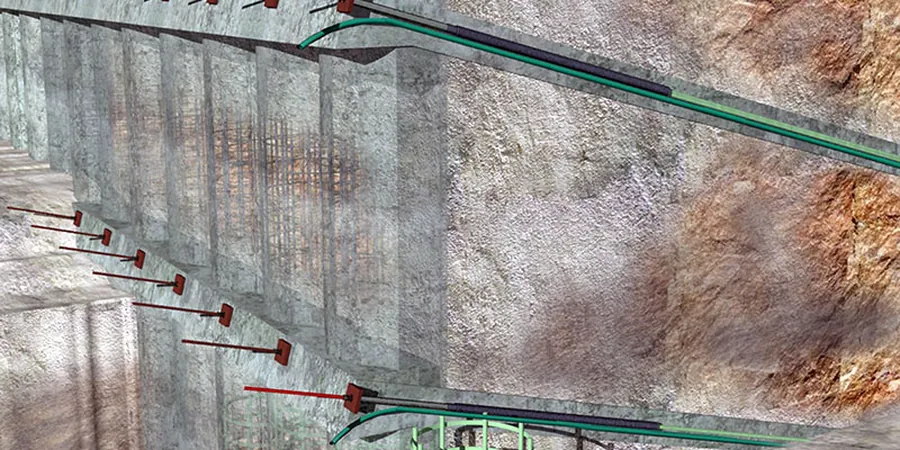
The first thing you notice when the drill rig sets up in a League City lot is the water. Not rain—never just rain around here—but groundwater, sitting barely five feet below the grass, dark and stubborn. The auger goes down through stiff Beaumont clay, and by the time you hit twelve feet you’re already pulling up saturated gray paste. That clay can swell fifteen percent by volume between August and January, and when it does, a retaining wall without a properly designed anchor system doesn’t just lean—it migrates. We’ve pulled tendon loads on Clear Creek embankments where the passive zone had softened so much from seepage that the wedge geometry had to be recalculated after every storm. In League City, the difference between active and passive anchor design isn’t academic; it’s a decision you make standing in a trench watching water bead along a cut face. We often pair anchor design with a slope stability analysis to map the failure surface before specifying the unbonded length, and when the stratigraphy gets erratic we run a CPT test to pick up thin sand seams that can bleed grout during installation.
In expansive clay with a five-foot water table, anchor design isn't about calculating capacity—it's about predicting how much of that capacity will still be there after two wet seasons.
Methodology and scope
The soil profile on the west side of Interstate 45, over by Magnolia Creek, tends to hold its structure a bit better—more overconsolidated, less lateral creep. East of the freeway, down toward Clear Lake, it’s a different story: fat clays with PI values pushing forty, and organic silt lenses that compress under tendon lock-off. We’ve seen a passive anchor block in that eastern zone lose twenty percent of its reaction within six months simply because the soil relaxed around the grout body. Active anchors—the ones we tension and test to 133% of design load per PTI DC35.1—perform better there because you’re locking in the force before the creep sets in. But the corollary is that the unbonded length has to extend well past the critical failure surface, often thirty feet or more, to keep the stressing pocket out of the active wedge. In the western neighborhoods, where the clay is stiffer and the groundwater table occasionally drops below eight feet in drought years, a passive system with shorter tendon lengths can be perfectly adequate for a basement wall or a bridge abutment. The key is knowing which side of I-45 you’re on before you sharpen the pencil.
Local considerations
ASCE 7-22 Section 12.13 requires that retaining structures in Seismic Design Category D resist lateral earth pressure increments without brittle failure, and League City—though not in a high-seismicity zone—still faces a design PGA of 0.08-0.10g on Site Class D or E profiles. The bigger concern here is not the shaking itself but the post-seismic loss of suction in partially saturated clays, which can trigger a shallow bearing failure behind a passive anchor block. IBC 2021 reinforces this with its prohibition on unreinforced gravity walls taller than six feet in expansive soils without a registered design. What keeps us up at night is the combination: a saturated clay slope on Clear Creek, a retaining wall with passive anchors designed for a dry-season profile, and a hurricane-spawned rain event that saturates the passive zone in forty-eight hours. The anchor doesn’t pull out—the whole block rotates because the soil in front of it turns to slurry. We’ve mitigated that on several League City projects by extending the anchor bond zone into the underlying Pleistocene sand where it exists, or by specifying active anchors with load cells that can be re-tensioned after major storm events.
Frequently asked questions
How much does anchor design and testing cost for a typical League City retaining wall?
For a standard retaining wall project in League City requiring active or passive anchor design along with proof testing, the engineering and field work typically ranges from US$1,050 to US$3,350. The final cost depends on the number of anchors, the depth of the bond zone, and whether long-term monitoring with load cells is specified. Projects near Clear Creek or other waterways may fall toward the upper end due to additional corrosion protection and groundwater handling requirements.
When should I choose active anchors instead of passive anchors for a League City project?
Active anchors, which are tensioned and locked off at a predetermined load, are generally preferable when you need to limit lateral movement of a retaining structure—such as a basement wall adjacent to an existing building—or when the soil behind the wall is a soft, high-PI clay that will creep under sustained load. Passive anchors develop resistance only when the wall moves, so they work well in stiffer soils and for temporary excavation support where some deflection is acceptable. In League City, the decision often comes down to how close the excavation is to Clear Creek or to neighboring foundations, and whether the project can tolerate a few inches of displacement over time.
What is the typical lifespan of a permanent ground anchor in League City’s soil conditions?
A properly designed and installed permanent ground anchor with Class I corrosion protection can last 50 to 75 years in League City’s Beaumont clay environment. The primary threats to longevity are sulfate attack on the grout and corrosion of the steel strand in the free-stressing length. We specify Type V sulfate-resistant cement for the grout and fully encapsulated epoxy-coated strand in the unbonded zone. Regular inspection of the anchor head and re-tensioning after major flood events are recommended to maintain design performance over the service life of the structure.