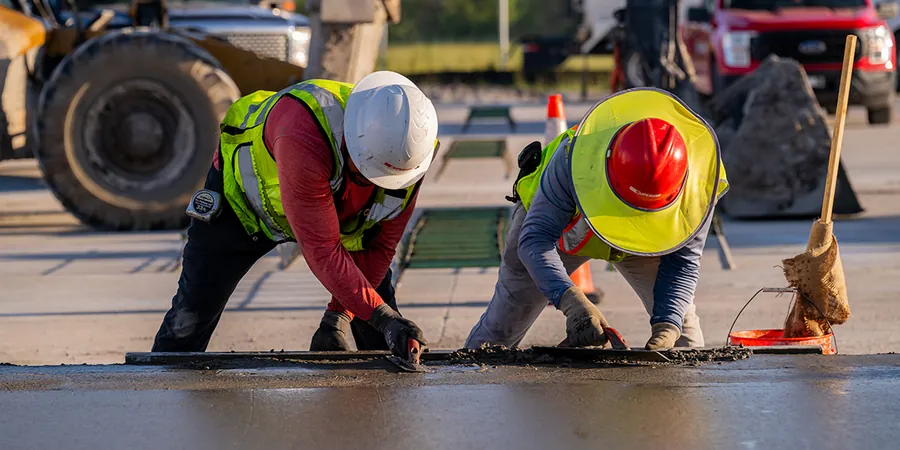
League City’s location along the upper Texas Gulf Coast presents a unique challenge for rigid pavement design: highly plastic Beaumont Formation clays that swell when wet and shrink dramatically during dry spells, creating differential movement that can crack even the most solid concrete slabs within a few seasons. With an average annual rainfall exceeding 50 inches and a water table that often sits just a few feet below the surface, moisture management becomes the defining variable in pavement longevity here. The team integrates subgrade stabilization techniques with structural design to interrupt the moisture cycle at the slab interface, because in this climate, what happens beneath the concrete matters far more than the mix design itself. A rigid pavement in League City lives or dies by its foundation.
In expansive clay territory like League City, the subgrade support value can drop by 60% between dry and wet seasons, making the drainage plan as critical as the concrete thickness.
Methodology and scope
League City’s rapid expansion since the 1990s, from a quiet railroad town of under 10,000 to a suburban hub surpassing 115,000 residents, has placed heavy demand on industrial pavements serving the petrochemical logistics and aerospace manufacturing sectors along the I-45 corridor. Our approach to rigid pavement design for these facilities starts with a comprehensive geotechnical investigation that includes Atterberg limits testing, because the plasticity index of the Beaumont clay directly governs the required thickness of the treated subbase. We then model joint spacing and dowel placement using finite element analysis calibrated to local load spectra, ensuring that the cumulative fatigue damage from frequent container yard forklifts or hangar ground support equipment stays within acceptable limits over a 25-year design life. The specification always includes a moisture-conditioned base layer with positive drainage outlets, following TxDOT Item 360 and 520 guidelines adapted for private sector applications.
Applicable standards
ACI 330R-08: Guide for Design and Construction of Concrete Parking Lots, ASTM D2487-17e1: Standard Practice for Classification of Soils (USCS), ASTM D4318-17e1: Standard Test Methods for Liquid Limit, Plastic Limit, and Plasticity Index, ASCE 58-10: Structural Design of Interlocking Concrete Pavement
Frequently asked questions
What makes rigid pavement design different in League City compared to drier parts of Texas?
The Beaumont Formation clays that underlie most of League City are significantly more expansive than the soils found in central or west Texas. Our designs must include a moisture-stabilized subbase layer, typically 6 to 8 inches of lime-treated clay or cement-stabilized sand, to buffer the slab from seasonal volume changes that can exceed 1.5 inches of vertical movement at the surface.
What is the typical cost range for a rigid pavement design on a commercial lot in League City?
For a standard commercial parking lot or industrial yard in the League City area, the geotechnical investigation and structural design package generally ranges from US$1,630 to US$5,410, depending on the number of borings required and the complexity of the joint layout and drainage plan.
How do you account for the high water table when designing concrete pavements near Clear Creek?
We install piezometers during the site investigation to measure seasonal groundwater fluctuations, and then design a capillary break and edge drain system that prevents water from ponding beneath the slab. The pavement cross-section is modeled assuming a reduced k-value for saturated conditions, so the slab thickness is never based on the overly optimistic dry-season subgrade support.
What joint spacing do you recommend for rigid pavement in expansive clay areas?
We typically specify joint spacing between 10 and 15 feet for plain jointed concrete pavement on expansive subgrades, which is shorter than the standard 15-foot spacing used on stable soils. Tighter joint spacing reduces the crack width potential from curling and warping stresses, and we pair this with larger-diameter dowel bars to maintain load transfer efficiency above 80% even as the subgrade stiffness fluctuates seasonally.