← Home · Laboratory

Grain Size Analysis for League City Soils: Sieve + Hydrometer Testing

Together, we solve the challenges of tomorrow.

LEARN MORE →

League City sits on the edge of Galveston Bay, and anyone who has dug a foundation here knows the soil profile changes fast. You start in a sandy loam, hit a pocket of fat clay by four feet, and suddenly you are staring at groundwater before you reach ten. The humidity and frequent tidal influence in this part of Texas mean the fines content in your soil sample is often higher than the borehole log suggests. Running a full grain size analysis—both the mechanical sieve stack and the hydrometer for the minus No. 200 fraction—gives us the real gradation curve. Without it, you are guessing on drainage behavior and shrink-swell potential, and in a city where the population has grown past 115,000 with new subdivisions pushing into low-lying areas, that guess can cost real money. In our experience, combining the sieve results with an Atterberg limits test on the same sample reveals whether that gray clay is a CL or a CH, which changes the foundation design entirely.

A single grain size analysis in League City can reveal whether your soil drains like beach sand or heaves like a sponge—two extremes that occur within the same subdivision.

Methodology and scope

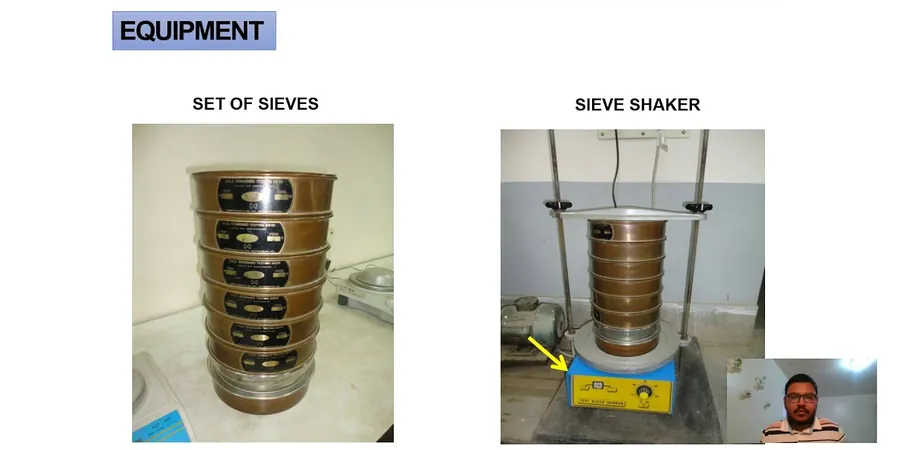
The most common mistake we see in League City is a geotech report that relies on a visual-manual classification and skips the hydrometer. A contractor grabs a handful of soil, calls it 'sandy clay,' and pours a slab on it. Two summers later the owner has cracks running diagonal across the living room. The problem is that coastal Texas clays carry a lot of silt-sized particles that look like clay but behave more like a granular soil when saturated. ASTM D422 and D6913 protocols separate these fractions quantitatively. We run the sieve stack from 3/4-inch down to the No. 200, then put the fines through a hydrometer sedimentation test with sodium hexametaphosphate as dispersant. The resulting grain size distribution curve tells us the exact percentages of gravel, sand, silt, and clay. When that curve shows more than 40 percent passing the No. 200 sieve and a plasticity index above 20—which happens often near Clear Creek—we know to recommend a mat foundation or an engineered fill pad instead of standard spread footings. For sites with deeper granular deposits, a CPT sounding helps correlate the gradation with in-situ density, giving us a fuller picture of settlement risk.
Grain Size Analysis for League City Soils: Sieve + Hydrometer Testing
Technical reference image — League City

Local considerations

IBC Section 1803 requires a soil classification based on laboratory testing for any structure in League City, and ASCE 7 ties the seismic site class directly to the shear wave velocity and the soil profile. Here is the catch: if you skip the hydrometer and misclassify a silty sand as a clean sand, you can end up assigning Site Class D when the material actually behaves as a Site Class E or F due to high fines content. That underestimates seismic demands. League City sits in a region where the USGS seismic hazard maps show low but non-zero acceleration values; the bigger risk here is not the shaking itself but the amplification through soft, fine-grained soils. A proper grain size analysis anchors the entire geotechnical model. It feeds directly into liquefaction susceptibility screening—we use the gradation curve to check against the Tsuchida criteria and the Bray-Sancio framework for fines-dominated soils. For sites near Dickinson Bayou or the many detention ponds scattered across the city, the gradation data also calibrates our slope stability models, especially when evaluating embankment fills that will sit partially saturated year-round.

Need a geotechnical assessment?

Reply within 24h.

Email: contact@geotechnical-engineering1.org

Technical parameters

ParameterTypical value
Standard test methodASTM D422 / D6913 (combined sieve + hydrometer)
Sieve range3 in to No. 200 (75 mm to 75 µm)
Hydrometer range0.075 mm to approx. 0.001 mm (clay fraction)
Sample mass required500 g for fine-grained; 5 kg for granular soils
Dispersing agentSodium hexametaphosphate (ASTM D422 compliant)
Reported coefficientsD10, D30, D60, Cu, Cc, % gravel, sand, silt, clay
USCS classification outputPer ASTM D2487, tied to gradation and Atterberg limits
Turnaround time3–5 business days (standard); rush available

Associated technical services

01

Combined Sieve and Hydrometer Package

Full ASTM D422/D6913 analysis from coarse gravel through clay fraction. You receive the complete grain size distribution curve, USCS classification per D2487, and a written interpretation of the soil's engineering behavior including drainage potential and frost susceptibility.

02

Gradation with Correlated Field Testing

We pair the lab gradation with SPT or CPT data from your League City site. The grain size curve calibrates the in-situ test interpretation, giving you a defensible friction angle estimate and a settlement analysis that accounts for fines content rather than assuming clean sand behavior.

03

Forensic Gradation Analysis

For existing structures with distress—cracking slabs, settling pavements—we sample the foundation soils and run a targeted grain size analysis to identify problematic layers. The results often explain differential movement that visual inspection misses, especially in the expansive clay zones common west of I-45 in League City.

Applicable standards

ASTM D422-63(2007)e2 – Standard Test Method for Particle-Size Analysis of Soils, ASTM D6913/D6913M-17 – Standard Test Methods for Particle-Size Distribution (Gradation) of Soils Using Sieve Analysis, ASTM D2487-17e1 – Standard Practice for Classification of Soils for Engineering Purposes (Unified Soil Classification System), IBC 2021 Section 1803 – Geotechnical Investigations, ASCE/SEI 7-22 Chapter 20 – Site Classification Procedure for Seismic Design

Frequently asked questions

How much does a grain size analysis (sieve + hydrometer) cost in League City?

For a standard combined sieve and hydrometer analysis per ASTM D422/D6913, pricing typically ranges from US$90 to US$210 depending on the number of samples and whether you need the full hydrometer sedimentation curve or just the minus No. 200 wash. Rush turnaround adds a surcharge. We provide firm quotes once we know the sample quantity and the reporting detail required.

Why do League City soils require a hydrometer test and not just a sieve analysis?

The Beaumont Formation clays and silts that dominate the near-surface geology here contain a high percentage of fines that pass the No. 200 sieve. A sieve alone lumps all that material into one fraction. The hydrometer separates silt-sized particles from true clay colloids, which behave completely differently in terms of plasticity, shrink-swell, and drainage. Without that separation, you risk misclassifying a CH as a CL, and that error cascades into your foundation design.

What sample size do you need for a grain size analysis in League City?

For predominantly fine-grained soils like the clays we encounter near Clear Creek and the bayous, we need about 500 grams of material. If your site has a significant gravel or coarse sand fraction—more common in the northern parts of League City toward the Harris County line—we require closer to 5 kilograms to get a statistically valid coarse fraction distribution. We can advise on sampling jars and procedures before you mobilize.

How does grain size analysis relate to the seismic site class for my League City project?

ASCE 7 uses the average shear wave velocity in the upper 30 meters to assign Site Class, but the soil profile type—which depends heavily on gradation and plasticity—is the fallback when Vs30 data is unavailable. A grain size analysis that reveals more than 10 meters of soft clay with high plasticity can push the classification toward Site Class E or F, which increases the design spectral accelerations. For critical projects, we recommend running the gradation alongside a MASW survey to get both the Vs30 and the material classification, eliminating the guesswork.
Location and service area

We serve projects across League City and its metropolitan area.

View larger map