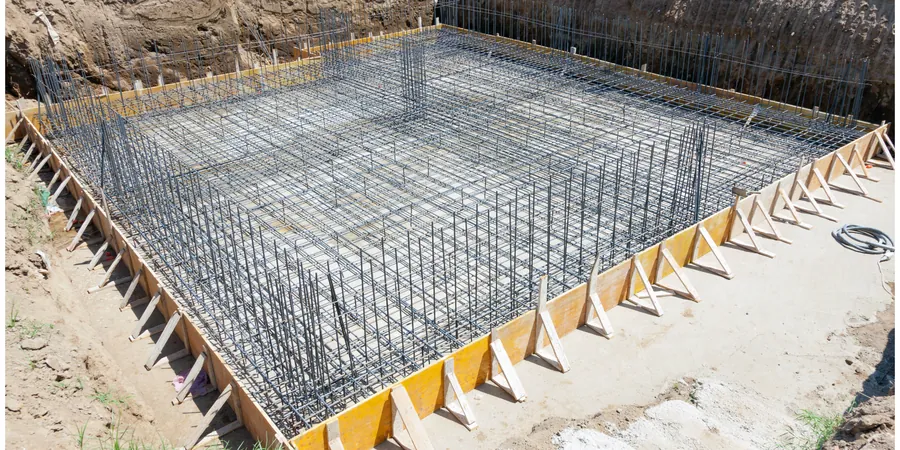
A three-story medical office building off South Shore Boulevard ran into trouble before the structural slab was even poured. The upper five feet of soil tested fine during preliminary grading, but the underlying Beaumont Formation clay was swelling to nearly three inches of potential vertical rise with seasonal moisture change. The developer had planned isolated footings until our field report showed differential movement exceeding IBC tolerances by a factor of two. League City sits squarely on the Gulf Coastal Plain, where Pleistocene-age clays alternate with silty lenses and occasional sand seams, a profile that routinely punishes conventional shallow foundations. Switching to a raft/mat foundation stiffened with perimeter grade beams let the structural engineer distribute the column loads across the entire footprint, cutting angular distortion below 1/500. That job taught us a lesson we have since applied from Clear Creek Village to Magnolia Creek: in this part of Galveston County, the difference between a successful slab and a distressed one often comes down to how early you integrate the geotechnical model with the foundation type.
On League City's Beaumont Formation clays, a properly stiffened mat foundation can reduce differential settlement to half an inch across a hundred-foot footprint, where isolated footings would rack and crack within three wet-dry cycles.
Methodology and scope
The International Building Code, as adopted by League City, references ASCE 7-22 for load combinations and Chapter 18 of IBC for foundation design, but the local reality adds layers that no generic code commentary captures. Our approach to raft and mat foundation design starts with ASTM D1586 standard penetration tests carried to a minimum depth of 20 feet, mapping the transition from desiccated crust into the softer, normally-consolidated zone where bearing capacity often drops below 1,500 psf. We correlate those N-values with laboratory Atterberg limits per ASTM D4318 because the Beaumont clays routinely show liquid limits above 50 and plasticity indices exceeding 30, classifying them as CH, fat clay, in the Unified system. For sites near Clear Creek or within the 100-year floodplain, we add
in-situ permeability testing using the Lefranc method to evaluate how quickly the subgrade will drain after a named storm drops twelve inches of rain in forty-eight hours. The mat is then proportioned as a beam on elastic foundation with a modulus of subgrade reaction derived not from a textbook table but from back-calculated plate load test data on similar League City profiles. Where the potential vertical rise exceeds two inches, we specify a void form system beneath the mat or recommend over-excavation with moisture-conditioned recompaction tied to a Proctor curve at 95 percent of maximum dry density.
Local considerations
What we see repeatedly in League City subdivisions built during the 1990s and early 2000s is edge lift distress on post-tensioned slabs where the mat was designed without accounting for the moisture gradient that develops under air-conditioned interiors. The center of the slab stays at a near-constant twenty-two percent moisture content while the perimeter fluctuates between ten and thirty percent depending on rainfall and drought, generating curling moments that exceed the cracking moment of the concrete within five to seven years. A deeper risk, less visible until it is catastrophic, is the presence of relict sand channels within the Beaumont clay that create preferential drainage paths: one corner of the mat drains freely while the opposite corner sits in perched water, and the differential heave can exceed four inches. The stone columns technique has proven effective on several of our League City projects where we encountered soft zones below fifteen feet, densifying the loose material and providing vertical drainage to accelerate consolidation before the mat is cast. We also watch for the interface between the Beaumont Formation and the underlying Lissie Formation, which occurs at variable depth across the city and can create a stiffness contrast that focuses settlement at the boundary.
Frequently asked questions
How much does a raft foundation design cost for a League City commercial project?
For a commercial building in League City, the geotechnical investigation and raft foundation design package typically ranges from US$1,030 to US$4,250, depending on the number of borings required, the depth of exploration, and whether we need to run swell-consolidation tests or finite element modeling. A smaller retail pad with two borings will fall toward the lower end; a multi-story medical office requiring four borings and advanced laboratory testing will be at the upper end.
Why are raft foundations recommended over isolated footings in League City?
The expansive Beaumont Formation clays that underlie most of League City produce differential heave and settlement that isolated footings cannot tolerate without distress. A raft foundation bridges across soft spots, distributes column loads so that bearing pressures stay below 1,500 psf, and provides enough stiffness to limit angular distortion to acceptable values under IBC Chapter 18.
What depth of exploration is required for a mat foundation in this area?
We typically take SPT borings to a minimum depth of 20 feet, and often to 30 feet for heavier structures, to penetrate through the active zone of seasonal moisture fluctuation and into the more competent material below. The goal is to capture the full thickness of the desiccated crust and the upper portion of the normally-consolidated clay so we can calculate both immediate and consolidation settlement accurately.
How do you handle the expansive clay risk under a mat foundation?
Depending on the measured potential vertical rise, we may specify over-excavation and recompaction of the upper four to six feet at moisture contents near optimum, install a void form system beneath the mat to accommodate swell, or design the mat as a structurally stiffened slab with enough reinforcement and depth to resist the calculated edge lift and center lift moments per PTI methodology.