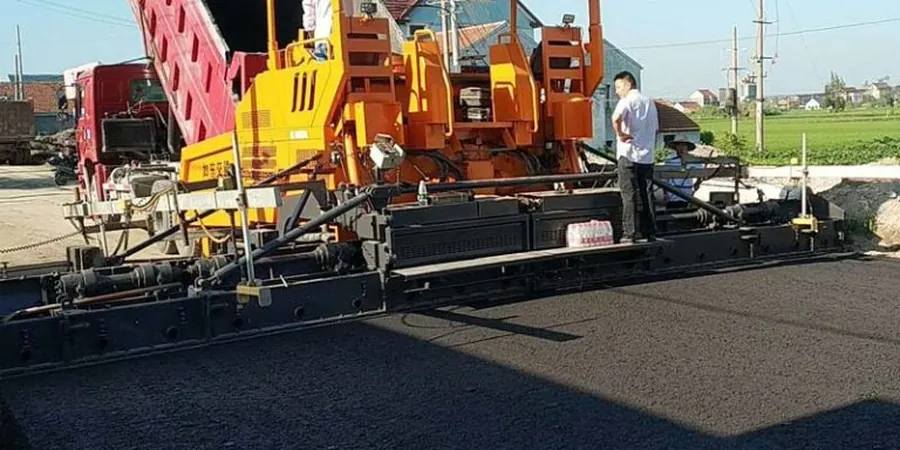
AASHTO 93 remains the backbone of flexible pavement design across Texas, but applying it in League City demands more than just plugging numbers into an equation. The city sits at roughly 20 feet above sea level, on soils that transition from Beaumont Formation clays to silty deposits near Clear Creek. This means the structural number alone is worthless without a reliable resilient modulus backed by local subgrade data. Our approach starts with site-specific CBR testing for roads to anchor the design inputs, then builds the layer coefficients around the real drainage conditions that define performance in this part of Galveston County.
League City's high water table and expansive clays mean a pavement layer coefficient is only as good as the drainage factor behind it.
Local considerations
League City's geography creates a unique stress scenario for asphalt pavements: prolonged saturation of the subgrade during hurricane season, followed by intense drying that opens shrinkage cracks in the underlying clay. This shrink-swell cycle, measured at a Plasticity Index above 25 in many neighborhoods near Clear Lake, pumps fines into the granular base and progressively reduces the effective structural number. The result is alligator cracking that appears far earlier than the design life predicted. When the pavement also serves as a flood barrier for adjacent properties during storm surge events, the consequence of under-designing the section goes beyond maintenance costs. Our team correlates Atterberg limits with the Thornthwaite Moisture Index for the Houston-Galveston area to assign a realistic equilibrium suction value, which feeds directly into the resilient modulus estimation used in the AASHTO equation.
Frequently asked questions
What typical pavement section does League City require for a residential street?
Most residential streets in League City are designed with 2 to 2.5 inches of Type D HMA over 8 inches of flex base, assuming a CBR of 5% or better in the subgrade. When the Plasticity Index exceeds 20, we recommend increasing the base thickness to 10 inches and adding a geotextile separator. The exact structural number depends on the 20-year ESAL projection, which for a low-volume residential road usually falls between 50,000 and 150,000.
How much does a flexible pavement design package cost?
For a typical League City project, the design package including subgrade investigation, laboratory testing, and the pavement structural calculation ranges from US$1,760 to US$5,000, depending on the number of borings and the complexity of the drainage analysis required.
How do you account for the expansive clay subgrades common in Galveston County?
We measure the Atterberg limits and percent passing the #200 sieve on samples from each boring, then apply the Thornthwaite Moisture Index for the Houston-Galveston region to estimate the equilibrium suction in the subgrade. This suction value is converted to an effective resilient modulus using the Enhanced Integrated Climatic Model (EICM), which gives a far more realistic input for the AASHTO 93 equation than a simple CBR correlation at optimum moisture.