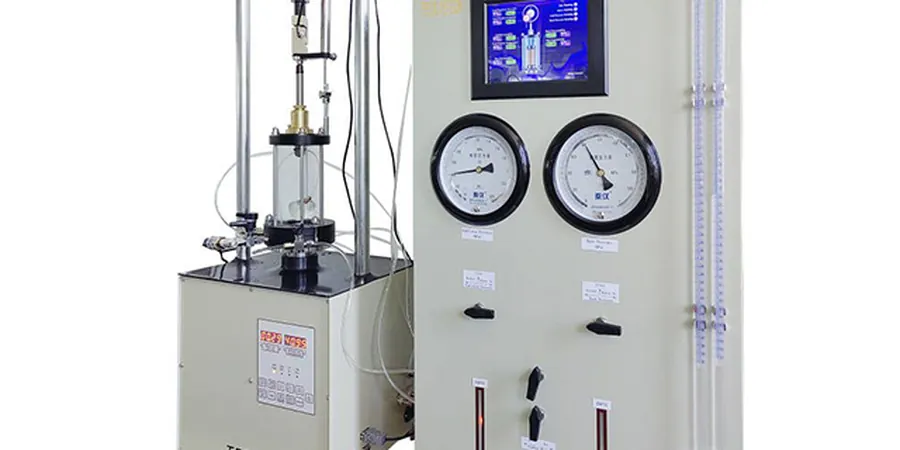
League City's development accelerated after the 1960s NASA expansion, transforming marshlands and prairie into subdivisions. The local geology, dominated by Pleistocene Beaumont Formation clays and silts with interbedded sand lenses, presents a specific challenge: these overconsolidated clays lose strength when saturated, a critical factor given the city's flat topography and slow surface drainage toward Clear Creek. For any project involving embankments, deep excavations, or heavily loaded shallow footings near the 29.5° N latitude, determining the effective shear strength is not a formality. A triaxial test provides the drained and undrained parameters—cohesion and friction angle—that direct simple shear or unconfined compression simply cannot resolve for multi-stage loading scenarios.
An effective friction angle derived from CU triaxial testing on Beaumont clay typically runs 5° to 7° lower than peak total stress values—ignoring that gap is what triggers long-term slope failures in Clear Creek watershed developments.
Methodology and scope
On sites west of I-45 where the gumbo clay runs deep, we consistently observe that remolded strength is only a fraction of the peak value. This sensitivity means that a standard penetration test alone won't predict how the soil behaves under deviatoric stress during a hurricane-season saturation cycle. A consolidated-undrained triaxial test with pore pressure measurement, run per ASTM D4767, gives us the effective stress friction angle—often in the 22° to 28° range for intact Beaumont clay. The procedure involves trimming an undisturbed Shelby tube specimen into a 2.8-inch diameter cylinder, saturating it under back pressure, and shearing it at a controlled strain rate. The resulting Mohr-Coulomb envelope then feeds directly into slope stability models or retaining wall designs. For granular layers encountered below 15 feet, we switch to a drained test per ASTM D7181 to capture the dilatant behavior of the sand without generating excess pore pressure.
Frequently asked questions
How much does a triaxial test program cost for a League City building site?
A standard set of three CU triaxial tests on undisturbed Shelby tube samples runs between US$2,150 and US$3,020, depending on the number of confining stages and whether modulus data is required. A single UU test falls at the lower end of that range.
What's the difference between the triaxial test and the unconfined compression test?
The unconfined test shears the sample with zero lateral pressure—it's fast but only gives undrained shear strength for saturated, intact clay. The triaxial applies controlled confining pressure, so it measures both drained and undrained strength at realistic in-situ stress levels and provides the friction angle that the unconfined test cannot.
How long does it take to get triaxial test results?
A CU test with three effective confining stresses typically requires seven to ten business days from sample extrusion to final report. Saturation alone can take 48 hours for stiff Beaumont clay. We expedite to five business days when the project schedule demands it, but the consolidation phase cannot be shortened without degrading the effective stress data.
Do you test granular soils in the triaxial cell for League City projects?
Yes. When borings encounter sand layers beneath the Beaumont clay—common along the Clear Creek alluvial corridor—we run consolidated drained (CD) tests on reconstituted specimens compacted to field density. This captures the dilation angle and critical state strength that govern pile end-bearing capacity in the sand stratum.